GANESHA
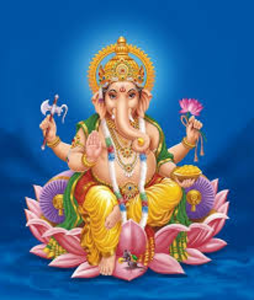
– GOD OF SCIENCE AND LOGIC THE SCRIBE OF ASTROLOGY
In the night sky, there are billions of Stars in the Universe, in a myriad of other Galaxies and our Galaxy, the Milky Way, is seen as a luminous band across the night sky. These Galaxies are fixed, from our vantage point on Earth because they are so far away and they form the backdrop to the ones that seem to move, The Planets that move in our closer view from Earth, that influence our lives, rotating around our Star, the Sun.
The background of the fixed Stars is called the Zodiac that have been divided by Astrologers in separate sectors of the night sky, 12 Constellations or Signs and further divided into distinct spaces, called 28 Nakshatras.
The heavenly bodies that move are called Planets (Grahas) that have their own distinctive character and influence. For predictive purposes Jyotish, (Vedic Astrology) looks at the positions of the planets in relation to the stars in the Zodiac and the relation to other planets at the time of your birth. These positions reveal how the universe was unfolding at that instance when you took birth. Planets are 9 special reference points from which the entire subtle state of the Universe and your destiny and history can be measured. At the time of birth, your Body and Mind chose to enter this Material World from the unmanifest (Dark Matter) to manifest your individual Destiny: this state of the universe is projected into your Individual Destiny. Therefore, the conditions of these nine measuring points, the nine planets, for the initiated astrologer, express the entire life span of probable events and circumstances for your individual Path.
The 9 Grahas: We just mentioned nine planets, even though only five of them are actual orbiting planets (Mercury, Mars, Jupiter, Venus and Saturn) around one Star, the Sun: One is a satellite, the Moon, orbiting the Earth and two are Astronomical Points, Rahu and Ketu, where the Sun and Moon are eclipsed. Each graha (planet) represents certain facets of human life.
Here is the list of the primary graha significations assigned by the sage Parashara (the author of Brihat Parashara Hora Shastra):
SURYA (Sun) signifies the soul.
CHANDRA (Moon) signifies the mind.
MANGALA (Mars) signifies energy.
BUDHA (Mercury) signifies speech.
GURU (Jupiter) signifies knowledge.
SHUKRA (Venus) signifies reproduction.
SHANI (Saturn) signifies grief.
Traditional Vedic astrology does not consider the influences of Neptune, Uranus, and Pluto.
The Grahas (planets) are constantly moving through the Zodiac manifesting your destiny.
The Celestial Orb or Firmament of the Zodiac is the divided into 12 equal segments called Constellations or Rashis (Signs of the Zodiac). Each of the 12 Rashis (Signs) occupies 30 degrees of the Celestial Orb. Each of the Rashis (signs) has a unique set of attributes that affect any Graha (planet) traveling through that sign. The signs are environments that affect the way a planet behaves.
Rashi Rulerships: Every unique Rashi (sign) has its particular planetary ruler.
Here are the 12 Rashis (signs) and Rulers listed in their natural order:
The Sun and the Moon rule over one sign each, Leo and Cancer while the rest of the Grahas hold rulership over two signs. Traditionally, Rahu and Ketu are considered not to hold rulership over any signs, although, some astrologers consider Rahu and Ketu to co-rule the signs of Aquarius and Scorpio respectively.
The Sign Rulerships are a permanent attributes of each Sign. ARIES (Mesha) is ruled by Mars. TAURUS (Vrishabha) is ruled by Venus. GEMINI (Mithuna) is ruled by Mercury. CANCER (Karka) is ruled by the Moon. LEO (Simha) is ruled by the Sun. VIRGO (Kanya) is ruled by Mercury. LIBRA (Tula) is ruled by Venus. SCORPIO (Vrishika) is ruled by Mars. SAGITTARIUS (Dhanu) is ruled by Jupiter. CAPRICORN (Makara) is ruled by Saturn. AQUARIUS (Kumbha) is ruled by Saturn. PISCES (Meena) is ruled by Jupiter.
The 12 Bhavas: The Zodiac is divided in one more way. Relative to the position of the Earth, the Zodiac is divided into 12 Bhavas (Houses). Just as the proper motion of planets is reflected by their degree positions in the Rashis (signs), the diurnal relative motion of the planets, as perceived from the Earth (that is illusionary) is shown by their placement in astrological houses.
The houses represent the various aspects of life. The planets and signs that occupy the bhavas (houses) in your chart will affect those areas of your life. The twelve bhavas (houses) represent the totality of the experience of a human being.
Here are the main significations of each house:
The First House represents the Self and Constitution
The Second House represents your Financial Assets and Family
The Third House represents courage and Other People
And The Fourth House represents happiness.
The Fifth House represents your children.
The Sixth House represents your enemies.
The Seventh House represents your spouse.
The Eighth House represents your vulnerable points.
The Ninth House represents your fortune.
The Tenth House represents your career.
The Eleventh House represents your income.
The Twelfth House represents the end of everything.
The 27 Nakshatras: The zodiac is divided into 27 Nakshatras, each of identical size. The first one is called Ashwini, and the others follow from there. The very same zodiac is also divided in a different way: into 12 Rashis (zodiacal signs).
Out of the 12 signs, the one that is rising in the East at the time of birth is of particular importance. It is called Lagna (Ascendant) and it is used as the main point of reference in analyzing the chart. The Lagna as we will see, is very important in your life. The Nakshatra rising in the East is also important.
So far, we have briefly covered the general principles of the three main components of Jyotish:
the Grahas (Planets), the Rashis (signs), and the Bhavas (Houses).
The positions of the planets in the signs and houses are depicted in what is called the Horoscope. Evaluation and understanding of the interactive influences of these three main elements constitutes Jyotish, the interpretation of your horoscope.