Course Content
INTRODUCTION
your Astrology: your birth right that gives understanding of the workings of the Universal Forces that include action and control, wisdom, enjoyment, life, peace, intellect and love. You were born into this world with an Agenda to complete - a choice of destinies reflected in your birth chart. The sooner you understand that Agenda and your strengths and weaknesses, the better you can capitalize on your strengths and resist your weaknesses, the better your life will fare. Life is all about choices: temptations resisted and opportunities seizedBasic Interpretation of the birth chart will introduce you to the most basic concepts and elements in Vedic Astrology. It covers the zodiac used, the way the chart is drawn, and gives you an understanding of the Grahas (Planets), Rashis (signs), Bhavas (houses) and Nakshatras. It also introduces you to the lordships of the Bhavas, and the use of the Lagna (Ascendant), which are based on the relationship of the Grahas and the Bhavas, and the Rashis and the Bhavas respectively. This section also explains the most basic interaction between the Grahas: Conjunctions and aspects. Interpreting Planets provides an in-depth approach to understanding a unique nature of each Graha in any particular horoscope. This includes a precise distinction between the strength, auspiciousness and quality of a Graha. Interpreting houses elaborates on the various techniques used to interpret how a bhava will function in the chart and estimate how the areas of life represented by the bhava will manifest in one's life. Interpreting the chart integrates the previous two sections and completes a basic level of the chart analysis. Varieties of charts introduces you to some other types of charts that are often used to enrich the basic analysis of the birth chart. All the principles of the earlier section can now be applied in additional contexts. Divisional charts elaborates in detail on the use of one of the chart types introduced in the previous chapter. This chapter concludes the first part of the tutorial, dealing with interpreting the chart. Predictions The earlier chapters dealt with interpreting the chart without concern for the timing of life events, and predicting when various potential will manifest. The next three sections deal with the subject of timing the predictions. The Dashas section will explain how the planets are activated in cycles, and cycles within cycles. The Transits section will explain how the ongoing movement of the planets affects the natal chart. The Varshaphala section will teach you the intricacies of the chart cast on one's birthday, or rather, the exact time that the Sun re-visits its natal position. Other topics The Compatibility section shows you how you can determine the romantic compatibility between 2 people. Remedial measures briefly covers what one can do to correct negative or undesirable tendencies in life.
0/6
PROCESSION OF THE EQUINOX
Added Refinement
0/2
THE LAW OF KARMA
The Basis of Astrology is the Law of Karma: that Actions in this life affect Outcomes in the next life. Birth time Astrology is possible if there is reincarnation of souls to fulfil their Karma Karma is the spiritual principle of cause and effect, where intent and actions of an individual (cause) influence the future of that individual (effect). The Horoscope is a map of the heavens (planets) plotted on paper as a chart with the twelve signs of the zodiac placed in twelve numbered houses. From this map of the heavens we can read the planetary influences on human beings, as well as the amount of free will people possess.
0/1
VEDIC CHART AND AREAS OF LIFE
Each House bhava represents a number of areas of life. Whereas Planets (Grahas) indicate the different aspects of our consciousness, the bhavas indicate what areas of life that consciousness is most strongly connected to, projected on and influenced by the planets influence. The Signs (Rashis) color that connection and give it very specific qualities
0/4
TRANSITS
For an event to happen in your life you first need the specific Birth Time Astrology: Example: Saturn in the 9th house is good for awareness: The placement of Saturn in the ninth house can make the natives religious, pious and spiritually inclined. If you were born 8 hours before: Saturn in the 5th house produces seriously sick children. The time you were born is prompted by Sanchita Karma: the Accumulated Karma of all your Lifetimes. It would be impossible to experience and endure all these Sanchjta karma in one lifetime. Drude (Heavy) Karma takes many lifetimes to conquer. Adrude (Light) Karma will take less effort to overcome. Prarabdha Karma is experienced through the present body and is only a part of Sanchita karma that is ripe (Prarabdha Karma) and to be addressed this lifetime. Prarabdha Karma is a collection of past Sanchita karmas that your soul selected to be experienced through this present body, in this present life. From this stock of Sanchita karma, a handful is taken out to address in one lifetime and this handful of actions, which have begun to bear fruit and which will be exhausted only on their fruit being enjoyed or addressed is known as Prarabdha karma. Prarabdha Karma is past Life Karma shown by the Position of your Ketu in your Vedic Chart. Prarabdha Karma: Known as the ‘purpose’ karma of this present lifetime, where the purpose is to fulfill part of your karmic dues, experiences and lessons set out for this incarnation. Prarabdha Karma are those lessons and experiences that we must absolutely face in this lifetime, no questions asked. Prarabdha Karma is akin to a scoop of Karma taken from the massive pool of Sanchita KarmaYour Birth Time Astrology is subsequently influenced by your choices this lifetime: Kriyamana (Present Karma): Every thought word, deed, decision & action we create in our current life. All Kriyamana karmas flow from Sanchita karma and consequently shapes our future. Kriyamana is the karma we are creating with our desires. Kriyamana karma, or present karma, refers more specifically to the instantaneous or immediate Kriyamana Karma the consequences of your actions and is represented by the position of Rahu in your Vedic Chart. Distinction can be made between Kriyamana Karma that emphasizes the cause-and-effect between your actions and their immediate results and Agami Karma: future karma generated by your current actions and choices with consequences later in this lifetime or in future lifetimes. You need also to be running the planets Dasha or Bhuki: Running the particular Planet;s Dasha (running Mars Dasha) or Mars Bhukti (Saturn into Mars) and your present time’s astrology is influences by your present day astrology including the TRANSITS of planets through a particular house That will prompt the ripening of a particular Karma That is precipitated by the transit of the planet through the house that contains the Karma in question How does Karma become Ripe? For something to happen to you, you need 3 influences 1. A Planet in a house that controls a Concern: Mars in the 12th house means the Loss of Freedom 2. Run the particular Planets Dasha (running Mars Dasha) or Mars Bhukti (Saturn into Mars) 3. The Transit of the planets across that House – Then you go to jail for as long as the Sanchita Karma lasts. be it for a Month as Mars transits the 12th House. An AHA moment Tulsidas, a Hindu saint, said: "Our destiny was shaped long before the body came into being." We do have Free Will: Limited to how Aware and Disciplined we are and the Weight of Karma As long as the stock of Sanchita Karma lasts, there is the cycle of birth and death. Part of Sanchita Karma is taken as Prarabdha karma for being enjoyed or endured this lifetime,. A Jiva (Soul) cannot attain moksha (liberation) from the cycle of birth and death, until the accumulated Sanchita Karmas are completely exhausted. All Astrological Yogas indicate past Karma – the position of planets in your chart control impulses and influences the trajectory of this life Example: We just finished doing Katlyn’s astrology, she has Rahu in the 12th house. We predicted Kaitlyn has real knowledge/focus on 12th house issues of death. Without knowing her Vedic Chart she already does elaborate death ceremonies to gain insight. An AHA moment revealed from her chart. But she was also warned she has a dangerous Yoga: From one act of anger, she could lose Everything, house, home and family.Rahu in Vedic Astrology represents Desires you pursue this lifetime. So Rahu is a blessing or a curse depending on the house that is in. Be careful what you wish for. If you deeply desire something, you will manifest it in your life, now or in the future.So say you have Mars in the 12th house: you are likely to loose your freedom either by Jail, Illness or Mental Instability such as Agoraphobia Other parts of the chart will tell which: Say its Jail You are likely to go to Jail when you are running Mars Dasha or Bhukti and Mars transits the 12th house and be released when Mars exits the 12th house The Effect of Ketu in the 12th house is prompted by the Transit of Ketu over the position of Ketu in the 12th house. Rahu in the 6th house is Good
0/2
NEW TOPIC
DESTINY and KARMA:
THE LAW OF KARMA The Basis of Astrology is the Law of Karma: That Actions in this life affect Outcomes in the next life. Birth time Astrology is possible if there is reincarnation of souls to fulfil their Karma / Destiny Karma is the spiritual principle of cause and effect, where intent and actions of an individual (cause) influence the future of that individual (effect). The Horoscope is a map of the heavens (planets) plotted as a chart with the twelve signs of the zodiac placed in twelve numbered houses. From this map of the heavens we can read the planetary influences on human beings, as well as the amount of free will people possess
0/2
LAGNA – ASCENDANT
Lagna Ascendant – influences your Character The Ascendant is what is coming over the Horizon at the time of your birth While Western astrology assigns pre-eminence to the Sun sign, Jyotish awards that position to the Ascendant, which gives more insight into your life particulars than does any other factor in the horoscope. You can look up typical Cancer traits There are a few reliable principles regarding predictions based on the Ascendant: • What is the Constellation of the Ascendant and its ruler • The strength of the planets in the various houses • Relationship of the Lagna lord with the owners of various houses • The house the Sun rules in the chart • The ownership of the other houses in the chart Own House JB So important questions are: What Constellation is in the Ascendant? What planet rules what house and in what house is that ruler found? How do the various planets aspect each other? And in what Dasha (your Major Time Period) will its effect be felt?My Lagna is Sagittarius.
0/3
The GRAHAS (PLANETS)
Planets There are nine Grahas “planets” in Indian astrology: Only five of them are planets, one is a star, one is a moon, and the remaining two (Rahu and Ketu) are special astronomical points where the Sun and Moon eclipses occur
0/5
PLANETARY RULERSHIP OF THE SIGNS
Vedic astrology employs traditional sign Rulerships: Mars rules Aries and Scorpio, Venus rules Taurus and Libra, Mercury rules Gemini and Virgo, the Moon rules Cancer, the Sun rules Leo, Jupiter rules Sagittarius and Pisces, and Saturn rules Capricorn and Aquarius.
0/1
STRENGTH OF PLANETS
The Shadbala is the calculated score by which an astrologer can assess the strength of the planet. The effects of a planet whether auspicious or inauspicious will be in proportion to its strength. This Shadbala strength calculation is based on the different 'Bala' or strength factors. In ascendant, Jupiter and Mercury are strong. In North, Sun and Mars are strong in 10th house. In west, Saturn is strong and Venus and Mars acquires the directional form of strength in South in 4th house. In Vedic astrology, the strength of a planet depends on its natural qualities and how it interacts with other planets. Planets also have a permanent strength, called Naisargikabala, that they produce regardless of their position. The Sun has the greatest permanent strength, while Saturn has the least. In descending order of strength, the planets are: Sun, Moon, Venus, Jupiter, Mercury, Mars, and Saturn.The capacity of a particular planet to strongly influence your life and choices depends upon its planetary strength. This strength is determined by such factors as: • The aspects between planets that are friends or enemies • The friendliness of the ruling planet of the house in which the planet is found • Directional strength. A planet placed in its exalted Constellation attains is greatest strength for good or evil.Auspiciousness and Quality: The qualities of the Graha determined by it sign, Nakshatra position etc. will be expressed most advantageously when the planet is auspiciously placed. The qualities will be expressed with struggle and grief when the Graha is afflicted. Of course, in most cases there is no black and white situation, and there is some balance of afflictions and supporting factors, that bring out the qualities of the planet in a variety of ways. Since the strength of the planet indicates how potent it is to manifest its qualities, it is best to have the Graha with desirable qualities be strong, and the Graha with negative qualities be weak. However, this concept of "what is best" is highly subjective to one's purpose in life. In the life of a monk, a strong and unafflicted Venus may be out of place, as it will likely cause marriage. In the life of a wrestler, one probably would not have much use for a strong Moon. And a powerful Sun, would not serve people whose destiny it is to be in service.
0/3
PLANETARY CONDITIONS
This lesson deals with the strength and character of a planet based on its position and aspects: Moolatrikona, Own house, Vargottama, Combustion, Retrograde Planets, Planetary War, Planetary Friendship, Mangal, Kujo Dosha, House Position of Ketu, Dispositor
0/7
RASHIS (CONSTELLATIONS/SIGNS)
Vedic astrology and zodiac signs differ in how they track the positions of planets and constellations: Vedic astrology Uses the sidereal zodiac, which measures the motion of planets against the fixed positions of stars. Vedic astrology is based on the Vedas, the oldest sacred texts of Hinduism, and the belief that a person's karma is related to the positions of the planets and stars. Vedic astrology also includes the sun, moon, and seven planets, each with a name and dates that differ from Western astrology. Zodiac signs Use the tropical zodiac, which measures the motion of planets against the position of the sun on the spring equinox. A zodiac sign is a symbol that represents a person's personality, emotions, and motivations. Each person has a zodiac sign for each planet, the moon, and the sun. Because of the Earth's tilt and whirl, known as precession, stars and constellations don't remain fixed. Each star moves roughly one degree every 70 years, so a person's Vedic zodiac sign may differ from their Western zodiac sign
0/2
ANOTHER TOPIC
ASTROLOGICAL YOGAS
0/1
PLANETS IN VARIOUS HOUSES
0/1
DASHAS AND BHUKTIS
All of the analysis applied so far has ignored Timing, without having any clue when events will take place.We have been interpreting the birth chart, but we have not made timed predictions on your life in general.The effects of each Yoga is seen in the Dashas and Bhukti periods when the particular planets involved are activated: so we refer to the tables of Dashas and Bhuktis to predict when a particular Yoga will emerge.
0/3
REMEDIES
Remedies to strengthen weak or well-placed planets include Gems, Meditation and Tantric practices.
0/2
PRASNA – REAL TIME ASTROLOGY
0/1
ACKNOWLEDGMENT
0/1
Vedic Astrology

The Lagna (Ascendant)
The sign rising at the Eastern horizon at the time of birth is of special importance. It is called the Lagna or the Ascendant. The Ascendant is as per definition the sign that is placed in the first house. There are two ways that the Ascending sign is of special importance. Because the 1st house signifies the personality, the body and the person’s life in general, the Ascendant will have a major influence on all of these areas. Whatever the qualities of the rising sign are, those qualities will become very predominant in life.

The second way that the Lagna is characterizing the chart, is by fixing up the way all the other signs are aligned with the 12 houses. For example, every chart with Simha (Leo) lagna, will have Kanya (Virgo) in the second house, Tula (Libra) in the third, etc. Therefore, the Lagna implies 12 sign-house combinations at once. Each sign will color the house it is in, just like the Lagna colors the life overall. Admitted, the other 11 houses are not as important as the first, but their lesser significance doesn’t prevent them from contributing to the overall tendencies in the chart with such a Lagna. 
Mesha Lagna (Aries Ascendant)

Vrishabha Lagna (Taurus Ascendant)

Mithuna Lagna (Gemini Ascendant)

Karka Lagna (Cancer Ascendant)

Simha Lagna (Leo Ascendant)

Kanya Lagna (Virgo Ascendant)

Tula Lagna (Libra Ascendant)

Vrischika Lagna (Scorpio Ascendant)

Dhanu Lagna (Sagittarius Ascendant)

Makara Lagna (Capricorn Ascendant)

Kumbha Lagna (Aquarius Ascendant)

Meena Lagna (Pisces Ascendant)


Mesha Aries Lagna

The following table for an Aries Lagna shows how the 12 Bhavas (houses) are aligned with 12 Rashis Aries Taurus Gemini Cancer Leo Virgo Libra Scorpio Sagittarius Capricorn Aquarius Pisces

Ascendant_table Mesha Aries Lagna 1

Unique effect for Aries Lagna Energetic, changeable personality.
Enjoys beautiful and refined possessions.
Good at communicating.
Easily changes his mind and moods.
Strong, fixed opinions and ideologies.
Obstacles tend to be about “working out the details”.
Sensuous nature; enjoys getting involved in partnerships.
Interest in occult-oriented spiritual matters.
Religious by nature.
Ambitious and practical, handles multiple jobs.
Desires gains and success, takes time to succeed.
Interested in meditation or spiritual practice, spends on idealistic grounds.
Characteristic tendencies : People with Aries rising are always restless and constantly on the move. Because their ruling planet is Mars, they have a great deal of energy and zeal which makes them courageous, independent, and motivated at their best, but angry and hot-tempered at their worst. They have a sharp intellect, but tend to be fixed in their knowledge and understanding patterns. These people love taking initiative and prefer to lead than to follow. They can become great leaders, if they manage to control their volatile tempers. Their ideas and moods can change easily, and they are unlikely to stick to one project for too long. They are quite materialistic and tend to accumulate wealth. However, since Saturn rules the 11th House, it usually takes them a lot of hard work and commitment before the fruits of their labor become significant. They enjoy communication and tend to get involved in many partnerships and/or relationships. Aries natives are likely to have a pleasant marriage with a beautiful, refined, and mild-tempered partner. In spite of their independent nature, they have a religious side and often display interest in some occult kind of knowledge. They tend to spend on good causes (like charities, etc.) as long as it does not pose a threat to their ambition of becoming wealthy.

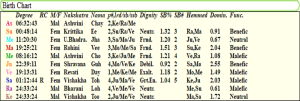
 

Mars Lord of Ascendant to 2nd with Sun
Rahu Ketu in Vertical Axis
Jyotishika Yoga: Mercury is located in a Kendra, the 2nd house lord is strong, and Venus is in exaltation in the 2nd house (Sarvartha Chintamani 3/35). The person will become foremost in a group of astrologers (Jyotish).
Tarkashastra Yoga: The Sun and Mars are together in the 2nd house (Bhavartha Ratnakara Ganitavidyajna Yoga: Jupiter is in a Kendra or a Trikona and Venus in it’s sign of exaltation (Sarvartha Chintamani 3/38). You are a mathematician.
Nicha-Bhanga Raja Yoga for Debilitated Jupiter
The debilitated planet is associated with or aspected by its debilitation lord.
This Yoga indicates cancellation of the state of debilitation of a planet and yielding benefic results instead, being elevated to Raja Yoga status.
Dan Yoga Charitable
Saturn in 8th house Rough childhood
Moon in 12th Addiction

Vrishabha Lagna (Taurus Ascendant)
The following table shows how the 12 Bhavas (houses) are aligned with 12 Rashis (signs) for Taurus.

Vrishabha Taurus Ascendant_table

Unique effect for Taurus Lagna: Practical, stubborn, and fond of comforts.
Talkative, lively in expression, and money-minded.
Not very courageous or competitive.
Favors having a permanent place of residence.
Intelligent and practical.
Spouse may be a cause of problems.
Temperamental partners.
Some problem involving (getting) children.
Steadfast, but practical in religious beliefs.
Hard working and involved in organizational or mental work.
Easy gains, comfortable income.
Impulsive expenditures on unworthy causes, accidents.
Characteristic tendencies : These individuals are often very fortunate and prosperous because of their basic tendency to stay in one place, stay focussed on their goals, and accumulate assets. They relate well to practical, down-to-earth matters, and have an excellent intellect and ability to express themselves. They have a prominent tendency to be somewhat conservative and stubborn, and do not welcome any type of changes. Patient and hard working, they are willing to sacrifice for the sake of the future. Their work may involve some long-term process with an idealistic flavor, where an idea is the key to success. They may encounter obstacles in the realm of parenthood. They may experience problems or delays in getting children, or deal with challenges raising them. Under the influence of their ruling planet Venus, they may be very fond of beauty, comforts, and harmony, as well as the opposite sex. But their marriage partner is likely to be a bit sharp and intense. There maybe a tendency of having disagreements with the partner or the partner may somehow be the cause of some problems in their life.

Mithuna Lagna (Gemini Ascendant)
The following table shows how the 12 Bhavas (houses) are aligned with 12 Rashis (signs) for Gemini.

The Lagnas Mithuna Ascendant Table

Characteristic tendencies : Mercury gives these natives a gift for speaking, as well as an interest in the arts and a predilection for learning. Gemini people are lively, intelligent, imaginative, and thirsty for intellectual stimulation.

Gemini individuals may excel in areas of literature, music, dance, or film, and will typically be very outgoing. Their great sense of humor makes them a welcome presence at social events. Their speech can be quite emotional, and their expressive face tends to give away how they feel. In spite of their apparent soft side, they can show a remarkable courage and enterprising spirit. Their career is likely to be in the realm of education or some branch of holistic knowledge. Initiating new projects is easy for Gemini natives, but taking work to the end and meeting the deadlines can be difficult. They can get bored fast and lose their interest in subjects that fail to challenge or amuse their bright intellect.

Their greatest challenge lies in their attraction to eroticism, gaming, or other sensual pastimes, as the interest in such matters may well reach the status of a “fatal attraction.” When treated unfairly or challenged, Gemini will fight back without mercy.

Karka Lagna (Cancer Ascendant)
The following table shows how the 12 Bhavas (houses) are aligned with 12 Rashis (signs) for Cancer.

Karka Cancer Ascendant_table

Characteristic tendencies : These natives are very sensitive and intelligent, but they may sometimes be nervous or easily stressed. Highly emotional and often psychic, they love pleasure and tend to acquire possessions. At their worst, they can be somewhat stingy; at best, they can be kind, supportive, and honest friends. In spite of their gentle and emphatic nature, they are capable of thinking and acting with vigor. Though Cancer natives are often unlucky in marriage, they are attached and devoted to their children and family. They typically marry a partner who surpasses them in age or overall maturity.

Simha Lagna (Leo Ascendant)

The following table shows how the 12 Bhavas (houses) are aligned with 12 Rashis (signs) for Leo.

Simha Lagna Table

Characteristic tendencies : Like the Aries type, Leo has a fiery disposition which creates courage and a strong sense of purpose, but which also increases anger and gives rise to a hot temper. Leo rising people are often ambitious as well, but may have to struggle to realize their objectives. They are typically cheerful, warm-hearted, sincere, and somewhat conservative. They often have a passion for the acquisition of knowledge. Happy married life is typically delayed, or the partner is somewhat distant – in age, culture, or physically.

Kanya Lagna (Virgo Ascendant)

The following table shows how the 12 Bhavas (houses) are aligned with 12 Rashis (signs) for Virgo.

Kanya Virgo Lagna Table 1

Characteristic tendencies: Though Virgo natives are highly skilled and extremely clever, they may lack self-confidence. Despite their clear discrimination, they may occasionally get carried away by their emotions. Mercury’s influence can make them ingenious, diplomatic, and shrewd, and enable them to rise high in life. However, they are extremely sensitive and may suffer from too much nervous stress. At times they get overwhelmed with anxiety over details and fail to see the big picture of an issue.

Tula Lagna (Libra Ascendant)
The following table shows how the 12 Bhavas (houses) are aligned for a Tula Lagna (Libra Ascendant)with 12 Rashis (signs) for Libra.

Tula Libra Lagna Table 1

Characteristic tendencies : The natives of Libra rising have a reputation of being too submerged in sensuality, but they are also quick-witted, forceful, and skilled at observing human nature with clarity. They are idealistic rather than practical, and the power of their ideals may wield a great, perhaps even hypnotic, influence over others. In such cases, it is difficult to reason with them. Due to the influence of Venus, they appreciate beauty and love music and arts.

Vrischika Lagna (Scorpio Ascendant)

The following table shows, for a Vrischika Lagna (Scorpio Ascendant), how the 12 Bhavas (houses) are aligned with 12 Rashis (signs) for Scorpio.

Vrischika Scorpio Lagna Table

Characteristic tendencies : These Scorpio people can be somewhat sarcastic and self-willed, though they may also become proficient in spiritual or occult arts, as well as more scientific concerns. Though sensualists by nature, they are also good at controlling their instincts and disciplining themselves. They love excitement and a challenge; they keep their own counsel and are not easily influenced by others.

Dhanu Lagna (Sagittarius Ascendant)

The following table shows how the 12 Bhavas (houses) are aligned for a Sagittarius Ascendant with 12 Rashis (signs) for Sagittarius.

Dhanu Sagitttarius Lagna Table 1

Characteristic tendencies : The typical Sagittarius rising personality loves religion and philosophy, but may be overly conservative in these matters. Active, enthusiastic, and enterprising, these individuals may also be somewhat nervous. They are extremely honest and even humble by nature, despising hypocrisy and superficiality. They often have good control over their emotions and sensual desires.

My Lagna is Sagittarius.

Makara Lagna (Capricorn) Ascendant

The following table shows how the 12 Bhavas (houses) are aligned for a Makara Lagna (Capricorn) Ascendant with 12 Rashis (signs) for Capricorn.

Makara Capricorn Lagna Table 1

Characteristic tendencies : Saturn may give these natives perseverance, a strong sense of purpose, and the ability to bear life’s difficulties with stoic calm. Capricorn natives are practical, ambitious, and responsible. They do not fear change and are flexible in their points of view. They are good at handling finances, and tend to be conserving. They are efficient and often successful in their undertakings due to their ability to work hard and remain focussed on the goals. Their practical aspirations that can lead them to great heights, although they may find little joy in their achievements. Their perfectionism may cause difficulties in marriage. At their best, they are philosophical and generous.

Kumbha Lagna (Aquarius Ascendant)

The following table shows how the 12 Bhavas (houses) are aligned with 12 Rashis (signs) for Aquarius

Kumba (Aquarius) Lagna Table 1

Characteristic tendencies : Philosophers and idealists by nature, favored with great literary or communicative skill,

Aquarians frequently make their mark on the world in terms of their ideas.
As personalities they can be timid, peevish, and chronically unhappy due to Saturn’s overpowering influence on their lives. Their health may be delicate. At their best, they possess great humanitarian instincts.

Meena Lagna (Pisces Ascendant)

The following table shows how the 12 Bhavas (houses) are aligned with 12 Rashis (signs) for Pisces.

Meena Lagna (Pisces Ascendant) Table 1

Characteristic tendencies : These natives can be deeply “spiritual,” though their spirituality is usually very orthodox and they will feel uncomfortable stepping outside of the mainstream. Dependent on others and frequently lacking in confidence, they are mystical and often psychic by nature. Typically honest and fair-minded, they make up in gentleness and kindness what they lack in forcefulness or personal power.

It is important to always consider the unique conditions of the house in question in an individual horoscope, before jumping to any conclusions based on the Ascendant (Lagna). Each individual sentence and statement may easily be counteracted by some other factor in a particular chart. For example, in case of Taurus nativity we said that the person would be talkative based on the fact the Mercury rules the Second House. This statement would be nullified, if Mercury were placed in the Twelfth House, the house of loss. A lot can be said about each Ascendant in general, yet there is virtually nothing than can be said for sure without considering the unique configuration of a particular horoscope.


Example HARPREMJEET

Mars Lord of Ascendant to 2nd with Sun

Rahu Ketu in Vertical Axis: Gives access to the Occult

Jyotishika Yoga: Mercury is located in a Kendra, the 2nd house lord is strong, and Venus is in exaltation in the 2nd house (Sarvartha Chintamani 3/35). The person will become foremost in a group of astrologers (Jyotish).

Tarkashastra Yoga: The Sun and Mars are together in the 2nd house (Bhavartha Ratnakara Ganitavidyajna Yoga: Jupiter is in a Kendra or a Trikona and Venus in it’s sign of exaltation (Sarvartha Chintamani 3/38). You are a mathematician. 

Nicha-Bhanga Raja Yoga for Debilitated Jupiter

The debilitated planet is associated with or aspected by its debilitation lord.

This Yoga indicates cancellation of the state of debilitation of a planet and yielding benefic results instead, being elevated to Raja Yoga status.

Dan Yoga Charitable

Saturn in 8th house

Rough childhood

Moon in 12th Addiction