The North Indian style chart
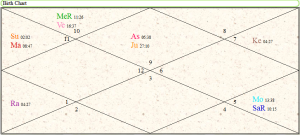

Right now you are looking at my actual Jyotish horoscope: my kundali chart formatted in the North Indian chart style. As you see, there are 12 individual sections in the horoscope. These sections are the bhavas (houses), and each house is fully occupied by one of the signs. The signs are marked within the bhavas (houses) with numerals. The numbering system used for marking the signs reflects the natural order of the signs (i.e. 1 – for Aries, 2 – for Taurus, 3 – for Gemini, 4 – for Cancer 6 for Virgo, 7 for Libra, 8 for Scorpio, 9 for Sagittarius, 10 for Capricorn, 11 for Aquarius and 12 for Pisces). The house counting sequence follows a counterclockwise direction, and so does the sign sequence within the chart. The box at the center top of the chart is called the First house. The sign occupying the first house is called the Ascendant. Your Ascendant is the sign which was rising at the eastern horizon at the time of your birth. The sign is indicated by its corresponding number. In your chart, the first house is marked with number 9, which indicates the sign of Sagittarius. Therefore, your Ascendant is Sagittarius. The box on the left of the first house is called the second house. The number 2 in that house represents the sign of Taurus. Next to it is the third house, then the fourth, and so on up to the twelfth house. The sequential order of the houses is FIXED in the North India chart format. The top center box is always the first house and the bottom center one is always the seventh. When using the North Indian style chart you should also remember that the numbers within the houses represent the sign numbers, not the numbers of the houses. For your convenience, here is a complete view: Each of the Grahas (planets) is placed in one of the bhavas (houses). The planets are marked in the chart with their abbreviated names. Now we see from the picture of your chart, which houses your planets occupy. The Sun, indicated by the letters Su, is in house 3. The Moon (Mo) is in house 9. Mars (Ma) is in house 3. Mercury (Me) is in house 2. Jupiter (Ju) is in house 1. Venus (Ve) is in house 2. Saturn (Sa) is in house 9. Rahu (Ra) is in house 5. Ketu (Ke) is in house 11. Once again, you should not confuse the house numbers with the numbers that you see in your chart. The numbers in the houses represent the signs that occupy those houses. The houses must be counted in a counterclockwise direction from the 1st house, which is the top center house. The houses should be counted inclusively of the house you are counting from. For example the 3rd house is located three houses away from the first one, not two, and 11th house is 5 houses away from the 7th, not four. E
Even though within this course we will always reference the chart in the North Indian format, you should learn the difference between North and South Indian chart styles. Let’s take a look at your natal chart drawn in the South Indian format.
The South Indian Style chart

Whereas the North Indian chart has a fixed house order, the South Indian format has a fixed sign order. The sign of Aries always falls on the second left box on the top of the chart. The house box that the Ascendant sign occupies becomes the First house with the remaining houses following in a clockwise direction. Commonly, the First house is marked with a diagonal line or with ‘As’ mark. Some astrologers choose to mark the houses with numbers, as opposed to the North Indian style, in which the numbers represent the signs.The basic Vedic astrology chart will show the placement of the Grahas in the 12 bhavas, and the alignment of the 12 Rashis with those 12 bhavas. From this very simple and profound schematic representation of the solar system at the time of birth springs forth a great number of calculations and considerations. Those, in turn, spin off a very elaborate web of interactions and relationships formed by the numerous significations of the Grahas, Bhavas and Rashis. Through this process, Jyotish is capable of expressing a rich range of human experiences, including contradictions of all sorts, and thereby doing full justice to the diverse and subtle aspects of life.
The Rashis and Nakshatras
Just like the Rashis, the Nakshatras also break up the zodiac into equally spaced segments. There are 27 Nakshatras, each taking up 13’20”. The Nakshatras are also called Lunar mansions, as the Nakshatra position of the Moon is an important use of Nakshatras. Each Nakshatra has a symbol, various attributes, and a planetary ruler. In order to clarify the use of Nakshatras, we will first explain the major differences between the use of Rashis and Nakshtras. –
Rashis are used to break up the chart into houses, as one Rashi corresponds to one house (the topic of the following lesson). Nakshatras do not correspond to any house, or to anything comparable. – The attributes of the Rashis are highly symmetric, with the order of male-female, and movable-fixed-dual repeating in a consistent pattern. The attributes of the Nakshatras are not like that at all, and their significance is not easily derived from a mathematical pattern as in the case of the Rashis. – Rashis are fully responsible for the dignity of the Graha, such as being in exaltation, in Moolatrikona etc. Nakshatras play no role at all in determining the dignity or any other attribute of the Grahas. – Rashis are used in the birth chart as well as in the divisional charts (vargas). Nakshatras are generally only used in the birthchart, and not in the divisional charts. – Rashis are used in many of the strength calculations that constitute ShadBala, but Nakshatras are not used at all. – The astronomically corresponding factor to a Rashi is the Solar month, whereas the Nakshatra is closest to the lunar day. (It takes one month for the Sun to pass through one sign, and it takes one day for the Moon to pass through one Nakshatra.) – Signs aspect each other. Nakshatras do not have aspects. – Nakshatras play a major role in the timing of the chart, and their order acts like a clock, activating the effects of the Grahas in the chart in a very particular order. The rashis also have a similar relationship to the Grahas, but much less emphasized/used. In general, one can say that the Rashis divide the zodiac to reveal more visible, objective aspects of the chart, and create a division of houses that represent the major areas of life where the Grahas act in.
Nakshatras divide the zodiac to reveal a more subjective cycle that is particularly relevant to understand our awareness and perception. The qualities of the Nakshatras are mostly derived from the symbols and mythological associations indicated in the Vedas. The accuracy and validity of these derived qualities can only be verified by the practicing astrologer. The most wide spread use of Nakshatras is through the unique system of dashas. Dashas are planetary cycles that divide life in major time periods, and each of those time periods in sub periods. Each dasha period has a precise starting and ending date, and during that period the influence of one of the Grahas (the dasha lord) will be felt more pronounced. Therefore, the prime use of the Nakshatras is to determine when the Rashi-based interpretations will manifest! The dasha system forms the link between our nakshatra based cycle of experience that activates our rashi based potential. For example, your first dasha cycle was of Venus, so your initial experience in life was strongly directed by Venus. To know what that means in concrete terms, you have to analyze it’s Rashi based position; Venus is in Capricorn, and in the 2nd house. The topic on dashas will be elaborately discussed in a future chapter. These are the 27 nakshatras and their dasha lords:
1. Ashwini Ketu
2. Bharani Shukra (Venus)
3. Krittika Surya (Sun)
4. Rohini Chandra (Moon)
5. Mrigashira Mangal (Mars)
6. Ardra Rahu
7. Punarvasu Guru (Jupiter)
8. Pusya Shani (Saturn)
9. Ashlesha Budha (Mercury)
10. Magha Ketu
11. Poorva Phalguni Shukra (Venus)
12. Uttara Phalguni Surya (Sun)
13. Hasta Chandra (Moon)
14. Chitra Mangal (Mars)
15. Swati Rahu
16. Vishaka Guru (Jupiter)
17. Anuradha Shani (Saturn)
18. Jyestha Budha (Mercury)
19. Moola Ketu
20. Poorvashadha Shukra (Venus)
21. Uttarashadha Surya (Sun)
22. Shravana Chandra (Moon)
23. Dhanishta Mangal (Mars)
24. Shatabisha Rahu
25. Poorvabhadrapada Guru (Jupiter)
26. Uttarabhadrapada Shani (Saturn)
27. Revati Budha (Mercury)
For the purpose of Muhurta, the Brihat Samhita classifies the Nakshatras in some broad groups that characterize their nature.
Each group is favorable for certain types of events, and these events give you a fairly good picture of the quality of that group:
Dhruva (fixed) Nakshatras The three Uttaras and Rohini are called Dhruva or Fixed. To be used for coronations, expiatory rituals, planting of trees, laying the foundation of towns, commencement of meritorious deeds, sowing seeds and other permanent things.
Tikshna/Daruna (dreadful): Mula, Ardra, Jyestha and Ashlesha. These are good for success in attacks, incantations, raising of goblins, imprisonment of others, murder, separation of friends and alliance with kings and the like. So if you care for raising a goblin, wait until the Moon is in one of those nakshatras.
Ugra (Fierce) The three Purvas (Purvaphalguni, Purvasadha and Purvabhadrapada), Bharani and Magha. They are to be used with success in ruining enemies, destruction, deceit, imprisoning, poisoning, arson, striking with weapons and murders and the like.
Ksipra (Swift) Hasta, Ashwini, and Pushya (Abhijit too) are termed Ksipra or Swift. They are beneficial for trade, sensual sports, education, decorations (or making ornaments), fine arts, skilled labor (like carpentry, smithy etc.), medical treatment, journey and the like (taking or giving loan etc.).
Mrdu (Tender) Anuradha, Chitra, Revati and Mrigasira. They are used with advantage in making friends, sexual union, use of garments and ornaments, performance of auspicious ceremonies (like marriage, Upanayana and Cudakarana) and singing.
Mrdutikshna/ Sadharana (Tender-Dreadful) Krittika and Vishaka. These yield mixed results.
Cara (Temporary) Shrvana, Dhanistha, Shatabhisa, Punarvasu and Swati. These are beneficial for emphemoral things.
We will now elaborate on the details of each Nakshatra. Since there is no one, complete authentic source on Nakshatras, we have to gather our information from several sources.
Parashara does not mention nakshatras for interpretive purposes at all. The Brihat Samhita uses Nakshatras in various ways related to mundane astrology (part of the Samhita branch of Astrology). In the Brihat Jataka interpretations are given for the Moon in the various Nakshatras.
Since the Moon rules the mind and emotions, the interpretations should be read as already being adjusted for the limitation of the Moon’s significations. The full significance of the Nakshatra is greater than that.