Yugas: The present era, according to Indian mythology is the Kali Yuga. It began over 3100 years ago. Prior to the Kali Yuga was the Dwapara Yuga, the Treta Yuga and the Satya Yuga: Making up a Maha Yuga of 4.32 million solar years.
The Principles of Vedic Astrology were narrated by Rishis and their illumination Maharishi Parashara in the Dwapara Yuga
The Kali Yuga is considered to be the lowest ebb of Divine Knowledge. Ganesh the scribe of Astrology is thought to have existed in the Satya Yuga.
Since humankind’s earliest days on Earth, the movement of the Sun across the heavens has garnered our rapt attention. We can measure the Sun’s path from two different vantage points: in reference to our own position on the Earth, or in reference to its path across the backdrop of the stars.
Tropical Astrology: For many purposes, such as hunting, planting and harvesting and other seasonal events, observing the Sun’s passage relative to ones’ physical location has been of vital importance.
Sidereal Astrology: The movement of the Sun and the other planets across the field of stars has been valued, for selecting propitious times for both mundane proceedings and spiritual rituals, for navigation, and for predicting astronomical events.
Prasna or Horary (present time) astrology; Muhurta or auspicious time; and Nimita- the interpretation of omens. The principles by Rishis and the fountain head is known as Maharishi Parashara in the Dwapara Yuga..
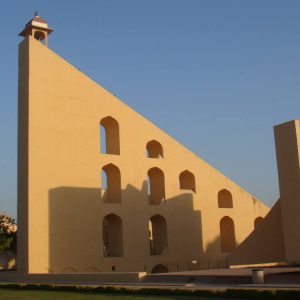
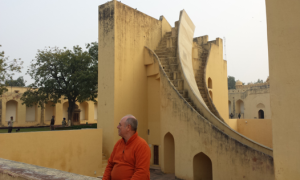
The Jantar Mantar, in Jaipur, is an astronomical observation site built in the early 18th century. It includes a set of some 20 main fixed instruments. They are monumental examples in masonry of known instruments but which in many cases have specific characteristics of their own. Designed for the observation of astronomical positions with the naked eye, they embody several architectural and instrumental innovations. This is the most significant, most comprehensive, and the best preserved of India’s historic observatories. It is an expression of the astronomical skills and cosmological concepts of the court of a scholarly prince at the end of the Mughal period.