Signs: Planetary Rulership of Constellations - House Rulership

Perhaps the most important use of the signs in Jyotish
is their role in house Rulership.
Once the Ascendant is fixed at birth the Constellations
are superimposed on the houses.
The symmetry of paired rulers of constellations is a beautiful concept to observe
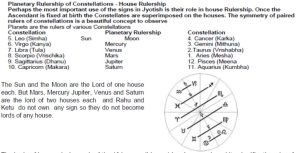
Planets are the rulers of various Constellations
The Sun and the Moon are the Lord of one house each Leo and Cancer respectively.
But Mars, Mercury Jupiter, Venus and Saturn are the lord of two houses each
Rahu & Ketu are astrological points given the status of planets but do not own any sign so they are not lords of any house.
The intricacy and importance of the house Rulerships in Jyotish cannot be underestimated
Once you understand House Rulerships you can divine which planet owns which house and where has that planet gone in the chart
To have two supportive house rulers together in the same house portends particularly well for not only the themes of both houses ruled, but also even more so for the house occupied.
The “AND” principle: Unlike planetary strength systems like Astrodynes in Western astrology, which add and subtract points to determine the final strength of a planet, in Vedic astrology, if a planet is both strong and weak, then both its strength and its weakness will express themselves in a person’s life. E.g. In the Dasha of Mars in Cancer (debilitated) in the 10th house (dig bala), Mars will manifest in both pioneering strength in career, and in career instability. There will be contradictions in your chart as the influences of various planets compete for an outcome. You can be poor and wealthy or a saint and sinner at different times of your life running different Planet Dashas
Lordships
The Rashi lordships of the Grahas play a key role in the interpretation of the birth chart. It is very important to thoroughly understand its principles. We have seen that each Rashi (sign) has a planetary ruler. We have also seen that each Rashi corresponds to a bhava (house). Whatever is the ruler of the Rashi, becomes the ruler of the corresponding house. Since most Grahas rule two Rashis, most Grahas will rule two houses. For example, Karka (Cancer) is ruled by Chandra (Moon). In your chart, Karka is in the 8th h., therefore, Chandra is the ruler of the 8th h.. Chandra only rules one sign, so that is the only house rulership it gets. Kumbha (Aquarius) is ruled by Shani (Saturn). Kumbha is in the 3rd h..
Therefore, Shani is the ruler of the 3rd h. in your chart. But Shani also rules Makara (Capricorn), which is in your 2nd h.. Therefore, Shani rules two houses, the 2nd h., and the 3rd h.. The ruler of the house fully represents the house. Wherever the house ruler is placed, it will cause an effect according to the nature of the one or two houses it rules. In your chart, Shani is in the 9th h., so it will carry the influence from the 2nd h. and 3rd h. to the 9th h.. Even though we said that the house is fully represented by the ruler, the way the influence is delivered varies greatly dependant on the Graha that is the ruler. The actual effects of the Graha are a mix of it’s own characteristics and of the house(s) it rules. Each Graha has a Moolatrikona sign, its “root” sign. If it rules two Rashis, it will more predominantly rule the Moolatrikona sign. Out of the two houses it may rule, the one corresponding to it’s Moolatrikona sign will be represented more predominantly. For example, the Moolatrikona sign of Shukra (Venus) is Tula (libra). The other Rashi ruled by Shukra is Vrishabha (Taurus). The house corresponding to Tula, 11th h., will be more represented by Shukra than the one Vrishabha is in, 6th h..
The Grahas not only represent the houses they rule by influencing the houses occupied, but also the other direction: a Graha fully represents a house and any influence on that Graha is interpreted as if it is on the house itself. For example, Budha (Mercury), rules the 7th h. and 10th h. in your chart, and is placed in the 2nd h.. Therefore, the areas of life represented by 7th h. and 10th h. get the influence of the qualities of the 2nd h.. An additional, more advanced interpretive principle is also applied. The distance of the house to the position of it’s lord is important. For example, the lord of your 7th house is in house 2. That is 8 houses away from the 7th. The principle here is that every house can be considered as the starting point, the lagna, for the areas of life it represents. If your 7th house is considered as the lagna (the lagna of the spouse), the lord of the 7th is in house 8. The interpretations that you derive that way are relevant for the area of life represented by that house. The interpretation of the house placement as counted from your own lagna is more relevant for you. In other words, using the house in question as the lagna, you take a step away from your point of orientation, towards the perspective of the person or area of life represented by the house. This principle will be illustrated in the comments on Parashara’s lordship interpretations. Parashara gives interpretations for each and every lordship combination. It is a very good exercise to study those and find the underlying logics used.
Lord of the 1st in the
1st 2nd 3rd 4th 5th 6th 7th 8th 9th 10th 11th 12th
Lord of the 2nd in the
1st 2nd 3rd 4th 5th 6th 7th 8th 9th 10th 11th 12th
Lord of the 3rd in the
1st 2nd 3rd 4th 5th 6th 7th 8th 9th 10th 11th 12th
Lord of the 4th in the
1st 2nd 3rd 4th 5th 6th 7th 8th 9th 10th 11th 12th
Lord of the 5th in the
1st 2nd 3rd 4th 5th 6th 7th 8th 9th 10th 11th 12th
Lord of the 6th in the
1st 2nd 3rd 4th 5th 6th 7th 8th 9th 10th 11th 12th
Lord of the 7th in the
1st 2nd 3rd 4th 5th 6th 7th 8th 9th 10th 11th 12th
Lord of the 8th in the
1st 2nd 3rd 4th 5th 6th 7th 8th 9th 10th 11th 12th
Lord of the 9th in the
1st 2nd 3rd 4th 5th 6th 7th 8th 9th 10th 11th 12th
Lord of the 10th in the
1st 2nd 3rd 4th 5th 6th 7th 8th 9th 10th 11th 12th
Lord of the 11th in the
1st 2nd 3rd 4th 5th 6th 7th 8th 9th 10th 11th 12th
Lord of the 12th in the
1st 2nd 3rd 4th 5th 6th 7th 8th 9th 10th 11th 12th